
Section’s latest AI Proficiency Report finds that enterprise organizations are moving on AI, but the workforce isn’t moving with them. Training, tool access, and daily usage are up from 6 months ago, but employee capability is lagging behind, and most workforces are not equipped to drive AI ROI for the business.
This press release features multimedia. View the full release here: https://www.businesswire.com/news/home/20260707482940/en/
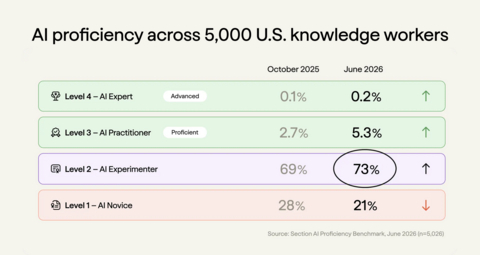
73% of the workforce are still AI Experimenters, or people who use AI for one-off tasks unlikely to drive AI ROI.
While 69% of workers say their company has taken some action on agents, fewer than 10% can correctly define what an AI agent is in their own words, and only 3.8% can write instructions to build an AI automation.
Overall AI proficiency remains just as rare. Only 5.5% of employees were judged by Section as a “practitioner” or “expert,” meaning they use AI regularly in ways likely to drive business value.
The research evaluated more than 5,000 U.S. knowledge workers on AI knowledge, usage, skill, attitudes, and organizational readiness, including hands-on assessments of prompting quality and AI use cases.
“The AI value gap isn’t closing because most CEOs keep skipping the hardest part of this work,” said Greg Shove, Section CEO. “It’s easier to buy licenses than to rebuild how a team operates – that’s the transformation layer, and almost nobody is doing it. You can see in this data the hole it leaves, from a workforce that can barely build a single automation to a management layer that’s quietly checked out.”
AI usage is rising fast. Proficiency is not.
More employees are using AI, and more often. 67% of knowledge workers now use AI at least weekly, up from 55% in October 2025. Daily use nearly doubled, rising from 22.5% to 36.7%. The share of workers with no valuable AI use case at all dropped 72% over the same period.
But usage gains haven’t translated into proficiency. Just 5.5% of the workforce meets the bar for AI proficiency today (Practitioner or Expert level). 73.5% are Experimenters – people who use AI for basic, one-off tasks with no repeatable workflow – and another 20.9% are Novices who barely engage with AI at all.
- Prompting skill is improving: 21% of workers can now write an effective prompt, up from 7% in October 2025
- But building remains a near-universal weak spot – only 3.8% of workers can write effective instructions for an AI automation
- The most common AI use case remains basic lookup: 61% of workers use AI as a Google search replacement
Employees are not ready to harness AI agents
Most enterprises have made some investment in agents: 69% of workers report their organization has given them access to agent-capable tools, encouraged agent use, or deployed an agent for a business process. But effective agentic use stops well short of that access.
- Only 16% of workers say they’ve they used an agentic tool at work
- Fewer than 10% can correctly define an AI agent in their own words
- At organizations that have deployed agents, only one in three employees has received agent-specific training
- C-suite executives are more than twice as likely as individual contributors to have access to agent-capable tools, and five times as likely to have received agentic training
This gap has real performance consequences. Workers at organizations that deployed agents and trained employees on them score an average of 47.5 out of 100 on Section’s proficiency benchmark, compared to 33.1 at organizations that deployed agents without training.
Companies are making moves, but the gaps are still wide
Organizations are investing more than they were six months ago: 62% of workers say they’ve received some AI training, up 40% from six months prior, and 53% now have clear access to sanctioned AI tools, up from 50% in October 2025. But the investment is uneven and often misaimed.
- 37.8% of workers have received no AI training at all; of those trained, only 17% were trained on agents or automation
- 53.2% of workers say their organization has no full-time Head of AI, or aren’t sure if one exists
Executives are excited. Everyone else, not so much.
The perception gap between the C-suite and the rest of the workforce hasn’t closed.
82% of C-suite workers describe themselves as excited about AI, compared to 30% of individual contributors. Anxiety runs the opposite direction: 8% of C-suite workers report feeling anxious or overwhelmed by AI, compared to 22% of individual contributors.
Compared to individual contributors, C-suite workers are far more likely to report that:
- Their org has a formal AI strategy (68% vs. 22%: 46-point gap)
- They’ve received AI training (91% vs. 44%: 47-point gap)
- Their org has a clear, actionable AI policy (77% vs. 37%: 40-point gap)
- They have clear access to AI tools (72% vs. 40%: 32-point gap)
- AI is widely integrated into workflows (57% vs. 18%: 40-point gap)
AI transformation is dying with managers.
Managers are the connective tissue between an organization’s AI strategy and the people who have to execute it. Employees whose managers expect and require AI use score 1.5x higher in AI proficiency and are 2.7x more likely to be excited about AI than employees whose managers set no expectations at all.
The problem is that most managers aren’t modeling the behavior themselves. Only 33% of managers use AI daily, just 5.4% meet the bar for proficiency, and fewer than half (49%) describe themselves as excited about AI – putting their own proficiency barely above the individual contributors they manage.
- 65% of managers either set no expectations about AI use or encourage it without holding anyone accountable
- Only 7.7% of managers require AI use and tie it to performance evaluations
- 37.5% of managers took no visible action on AI in the past 30 days
“This data confirms what we suspect. CEOs will announce more layoffs due to ‘efficiency gains from AI,’ but these gains are more hope than reality,” said Shove. “AI is a convenient scapegoat without yet meaningfully driving workforce transformation.”
Download the full report for the complete findings, including what AI experts inside the enterprise look like today and five tactics leaders can use to close the readiness gap – and join Section’s Co-Founder and Head of Product, Taylor Malmsheimer, for a live debrief of the results.
About Section
Section is an AI transformation partner that combines software and services to help enterprise organizations get value from AI. Section works with organizations to set ambitious AI strategy, enable sustained AI use, deploy and govern agents, and measure ROI. Founded in 2019 by Scott Galloway and led by CEO Greg Shove, Section has partnered with more than 150 enterprise organizations on AI transformation.
View source version on businesswire.com: https://www.businesswire.com/news/home/20260707482940/en/
Media gallery


